Chapter Two – What She Had Seen Before
The young nurse had learned early in her career that emergencies were rarely as dramatic as people imagined.
Most disasters did not announce themselves with alarms.
They began with small departures from the expected.
A pulse slightly different from the previous one.
Skin too cool.
A patient answering half a second too slowly.
A number on a chart that seemed harmless until placed beside another number recorded an hour earlier.
Medicine, she believed, was partly the discipline of refusing to ignore small things.
That belief had cost her popularity before.
It was about to cost her more.
The senior doctor stood several steps away, watching her.
“What did you change?” he repeated.
She did not answer immediately.
Instead she examined the unconscious man again.
His breathing had altered.
Barely.
But enough.
She bent closer, watching the rise and fall of his chest.
The doctor noticed.
“What?”
She pressed two fingers to the man’s wrist.
“His response is worsening.”
“He has been unstable all evening.”
“That is not an explanation.”
“It is a clinical fact.”
She looked at him.
“No. It’s a description.”
The doctor’s mouth tightened.
He had treated powerful families for decades. People trusted his discretion precisely because he never looked surprised, never raised his voice, and never allowed uncertainty to become visible.
The nurse was beginning to understand why his calmness bothered her.
It was not that he was composed.
It was that he seemed determined to remain composed even when reality changed.
She remembered the first time she had entered the suite that evening.
The unconscious man had still been awake then, though clearly unwell.
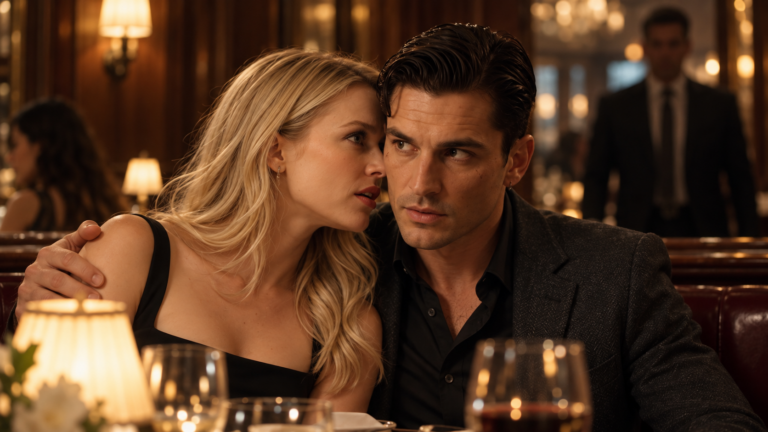
He had been sitting near the window with his black shirt open at the chest, one arm resting across his stomach. He had refused the bed because he said lying down made him feel worse.
The doctor had told him it was exhaustion.
The man had laughed.
“People keep calling everything exhaustion when they don’t want to explain it.”
The nurse had glanced up.
The doctor had not appreciated the comment.
Later, when she was alone with the patient for several minutes, he asked her quietly, “Do you believe him?”
She had known who he meant.
She should have answered professionally.
Instead she said, “I believe what I can verify.”
He had looked at her for a long moment.
“That sounds lonely.”
“What does?”
“Trusting evidence more than people.”
She had adjusted the blood-pressure cuff.
“Evidence usually doesn’t take it personally.”
That earned another faint smile.
There had been nothing romantic in the exchange.
Not really.
Yet the nurse remembered it now because of the way he had looked at her afterward.
Not as staff.
Not as a young woman expected to obey the older man in the room.
As someone whose opinion mattered.
That mattered more than she wanted it to.
Now he could not speak at all.
The doctor approached the IV stand.
“Step away.”
She remained where she was.
“You need to call emergency services.”
“No.”
The answer was immediate.
Too immediate.
The nurse stared at him.
“No?”
“He is already receiving care.”
“In a bedroom.”
“In a controlled private environment.”
“With no full resuscitation team, no immediate imaging, and no proper emergency support.”
The doctor’s expression sharpened.
“You are exceeding your role.”
“His condition is exceeding this room.”
For several seconds neither moved.
The chandelier gave off a soft, luxurious glow above them.
It was absurd how calm the room looked.
The nurse glanced again at the IV bag.
There it was.
The detail that had first bothered her.
Not a dangerous secret she could name yet.
Only an inconsistency.
Enough to demand caution.
She adjusted the line carefully, changing its flow and isolating what concerned her rather than allowing it to continue unquestioned.
The doctor saw.
“What have you done?”
She looked directly at him.
“What you should have done when he stopped responding normally.”
The doctor’s face lost colour.
Not much.
Only enough for her to see it.
And suddenly she understood something worse than disagreement.
He was afraid she might be right.