The empty space on the wall frightened me more than a broken window would have.
A thief would have left damage. A thief would have scattered brushes, overturned a chair, forced the lock.
Whoever had taken my painting had straightened the easel beneath it and swept the dust into a neat pile beside the door.
They had treated the disappearance like ordinary housekeeping.
I stood in the middle of my Paris studio with paint drying between my fingers, staring at the pale rectangle on the brick wall. For seven months, that painting had been the first thing I saw each morning.
Now there were only two hooks and a clean patch where the afternoon light had never reached.
Behind me, Claire set her leather bag on the worktable.
She did not ask what was wrong.
That was how I knew she already knew.
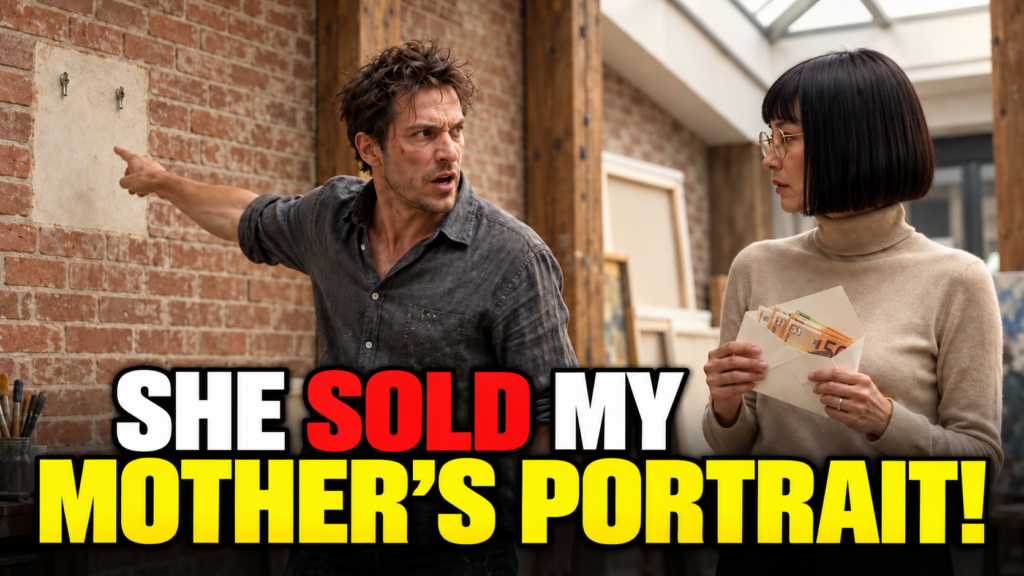
I pointed at the wall.
“Where is it?”
She adjusted her gold rimmed glasses and looked past me, toward the skylight.
“We should discuss this calmly, Julien.”
I was thirty two. Claire was thirty eight. For nearly three years, I had allowed her to speak to me as though those six years represented an entire lifetime of wisdom I lacked.
She knew galleries, collectors, the correct names to mention at dinners.
I knew how to make a face appear alive under layers of oil.
“Between us,” she used to say, “we have everything necessary.”
That afternoon, she opened her bag and took out an envelope.
The paper was thick and cream colored. Through its unsealed edge, I could see banknotes.
“Your share,” she said.
I looked from the envelope to the empty wall.
“You sold it?”
She held out the money.
“A serious offer came in. There was no time to hesitate.”
My mother had been dead for eleven months.
The painting was the last portrait I had made of her.
Claire knew that.
She knew why I had refused to put a price beside it. She knew why, whenever someone admired it, I thanked them and turned their attention toward something else.
Yet she stood in my studio holding cash as though grief were a transaction she had completed efficiently.
I knocked the envelope from her hand.
Notes slid across the table and fell among the paint tubes.
She said my name sharply.
I stepped forward and slapped her.
Her glasses twisted sideways. She stumbled back against a wooden easel, caught herself, and stared at me.
The sound seemed to remain in the room after my hand had fallen.
I wanted to tell you this differently.
I wanted the story to begin with a man who stayed composed, gathered evidence, and spoke with perfect restraint.
Instead, it began with an act I had no right to commit.
What she had done did not excuse what I had done. I knew that even before she touched her cheek.
I stepped away.
“I should not have hit you,” I said.
My voice sounded unfamiliar.
Claire straightened her glasses with trembling fingers. For the first time since entering, she looked directly at me.
“You have just destroyed any chance of handling this professionally.”
Perhaps I had.
But the painting was still gone.
“Tell me where it is.”
She picked up her bag.
“I will speak to you when you are capable of behaving like an adult.”
Then she left me with scattered money and an empty wall.
I did not follow her.
I locked the door, sat on the floor, and stared at my hand until evening swallowed the studio.